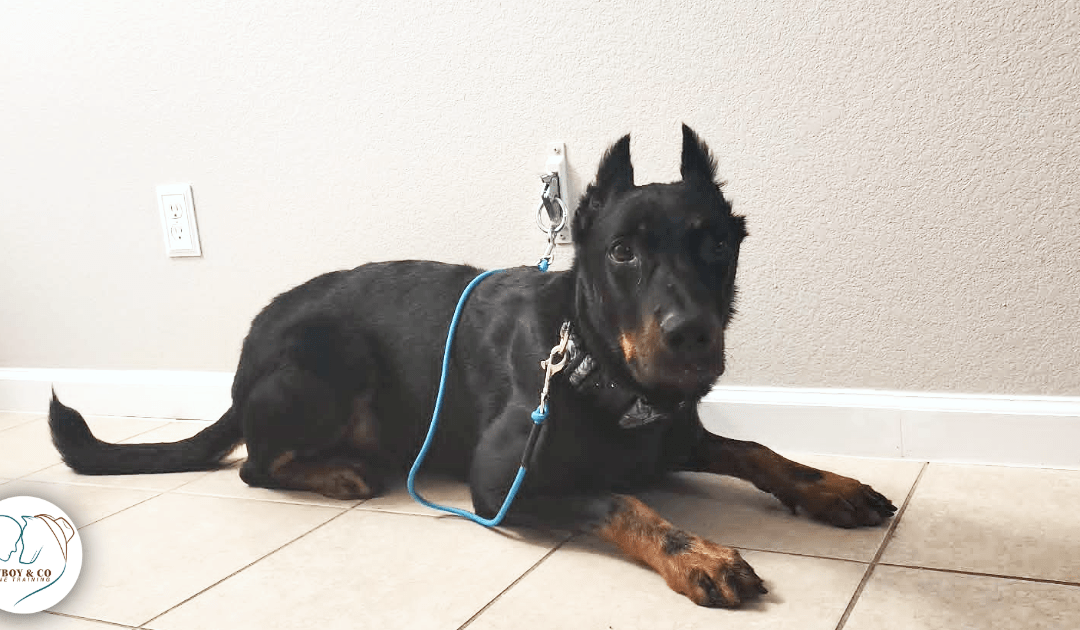
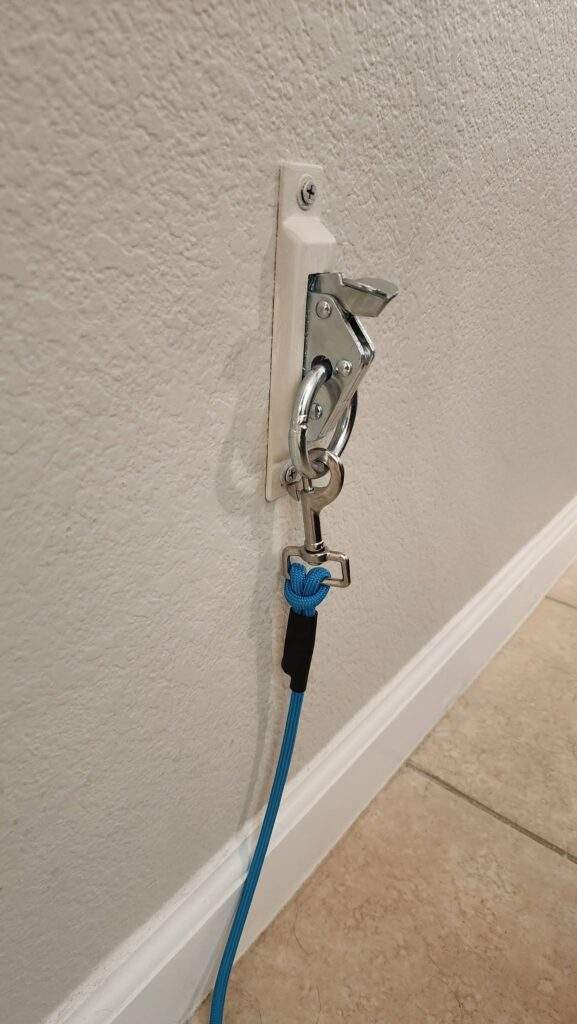
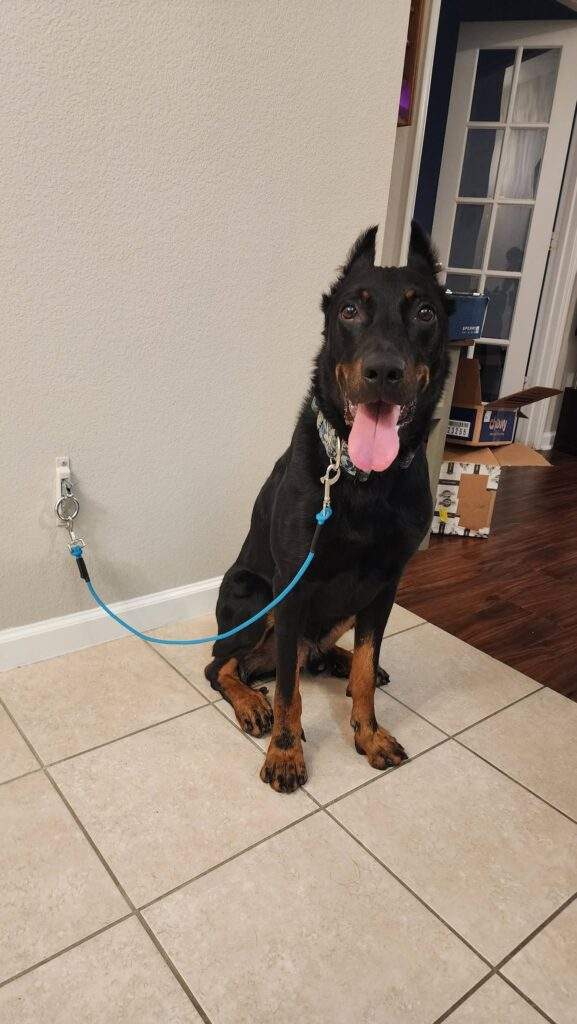
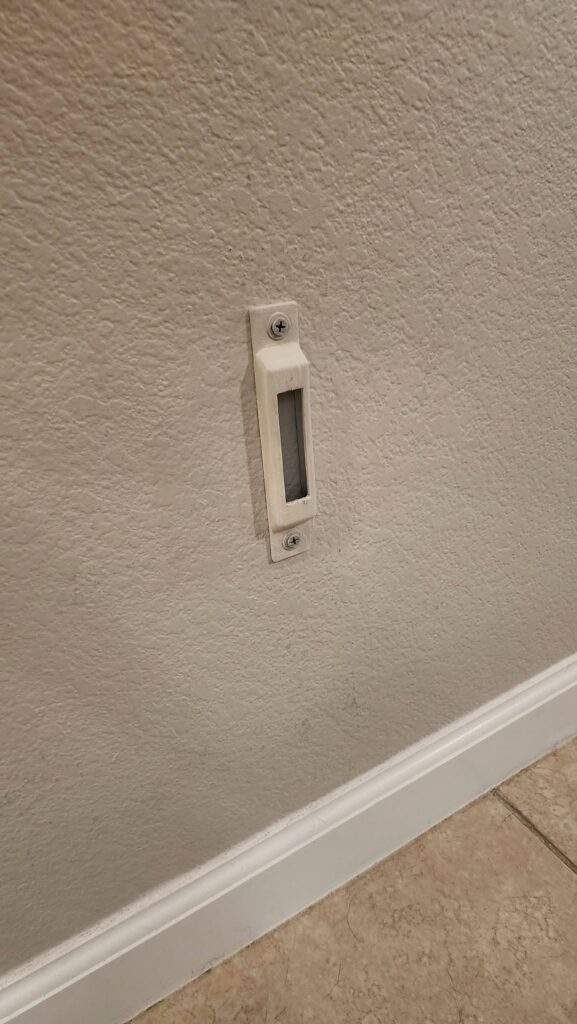
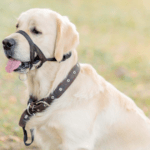
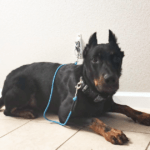
A recent Facebook post about a wall-mounted tether system went way further than I expected — and I mean it blew up. Some people loved it, some had questions, and a few jumped straight to worst-case scenarios. So let's back up and talk about tethering: what it is, what it isn't, and how it can make a real difference to a dog.
Tethering is for Training
Let’s hit the big concern first: tethering doesn’t replace a crate and you can’t tether your dog and leave them. A tethered dog is never alone. I'm either in the room working with them, or at a small distance keeping an eye on things. The point of tethering is training. It teaches them to settle, to stay close, and to be part of what's happening without getting underfoot or getting into trouble. The important thing there is that you never leave a dog alone after you tether them.
The same goes for safety and security. Before I bring another dog into the room while I have one tethered — say, tethering one dog while I actively work with another — I've checked that the anchor point is solid. I’ll never skip that step because I’m in a hurry. This setup makes it possible to safely work with a reactive dog: the other dog stays tethered and settled while I'm giving my full attention to training. Remember, I am the only trainer at Cowboy & Co, so sometimes I need an extra pair of hands. Tethering offers that.
Stationary Tethering
In stationary tethering, the dog is anchored to a fixed spot — a wall, a table leg, a door — while I'm awake and present in that space. The dog learns to settle near me without needing my direct attention, and just as important, it keeps them safe while they're awake and I've got my hands full. Some people use this in a way you may not expect: they keep something like this right outside a door, so they can hook the dog up for a minute while they run in and grab their keys or bring in groceries. It gives them a safe place to leave their dog while they do something else quickly.
There’s more than one way to set up a tether! While the hardware I used is one option, there are many more available. Eye bolts are the classic version — solid, but they stick out, and I've caught a leg on one more than once. D-rings that fold down when they're not in use solve some of that, though they still stand out visually. The e-track setup I posted about is the one I landed on for my own walls, mainly because it's low-profile, extremely sturdy, and paints to match.
But you don't need to drill a single hole to do this. I've used a 10-pound weight — the kind made for canopies and tents — and just tied a leash around it. If I need more resistance for a bigger or stronger dog, I'll stack a couple. I've tethered to a table leg, a couch, a door. All of it works, as long as it's heavy enough or secure enough that the dog can't drag it around. That matters most for anyone renting, or anyone who doesn't want holes in a wall.
Tethering to a person — sometimes called the umbilical method — is a different tool with a different job. The dog is clipped to me, usually at my belt, and goes wherever I go for a stretch of time. This is especially useful for puppies. They learn to stay oriented to me instead of wandering off and getting into trouble.
This payoff is quick. House training gets easier because I catch the signals before an accident happens. A puppy learns that being close to me doesn't mean I’m going to entertain them and that impulse control lesson is vital. And for a puppy still figuring out what's furniture and what's a chew toy, staying attached to me for a chunk of the day means fewer opportunities to make a mistake I’ll have to fix later.
The Benefits of Tethering (No Matter Which Method)
Whether you tether your dog to a wall or to you, the two aren't mutually exclusive. Plenty of dogs have never, ever been tethered with either method. However, the two methods support similar outcomes, such as impulse control and self-soothing. You can also:
Tether a puppy (or dog) while you leave the front door open to go to and from the car
Show dogs they don't have to maul every visitor
Begin to teach the "place" cue easily
"I'm not a professional, but with Johnny I used a regular leash and kept it and him with me all the time for about the first month after I adopted him. Now, if he's having trouble settling down at home I can just clip the leash to his collar and he will settle and lay down. It doesn't need to be clipped to anything, it's just the leash itself is the cue."
— Kenzie
A Few Things to Always Check
Regardless of how I’m tethering, a few things are non-negotiable. I don't use a slip lead where a dog can choke themselves by continuing to pull. But I’m also watching for signs of stress, if a dog is fighting the tether and cannot settle, they’re probably losing the lesson.
Also important: The tether line should only be long enough to let your dog stand up, turn around, and lie down again. Any longer and you risk your dog running to the end and actually breaking the hardware away from the wall.
Sometimes, I'll use a 6-foot leash as a tether, but it really depends on the circumstances and whether I feel like it's what the dog needs and is safe.
I'm Not the Only One Who Tethers Dogs
What surprised me most about the response to that post was how many other trainers and dog owners had already been doing some version of this on their own, often for years, with setups I'd never have thought of. One person's been using a wood block wrapped in sheep's wool with a coated tie-out wire run under a closed door. Someone else uses a ceiling mount attached to a wall stud with a swing hook. A few people are using heavy-duty suction cups so they can move the anchor point around as needed. One woman told me she'd been tethering in her own home for ten years and always figured she was one of the only ones doing it — until she saw how many people showed up in the comments doing the exact same thing.
That's the part worth thinking about. This isn't some fringe idea I invented. It's a tool a lot of experienced dog people already use because it works. If it's new to you, that's fine — welcome to the conversation.
Summer is here and it’s time to think about keeping our dogs safe from heat stress and heat stroke.
I don’t know about you, but I am busy arranging training sessions to avoid the summer heat while still giving my clients what they need for their dogs. The short answer is… it depends.
Grassy, shaded parks are mostly okay — but across the DFW metroplex, the morning air temp is already pushing 85°F, and the asphalt has hit 110°F. That changes things quickly.
Because I go to my clients, hot summer weather in East Dallas means I have to adjust every training plan around temperature. Knowing the best times of day, where the dog can actually get their needs met, and whether there’s real shade (not just a tree that looks helpful) becomes critical.
The dog’s health and safety come first. Always.
Heat Stress and Heat Stroke Are Not the Same
Before a dog ever shows signs of heat stroke, heat stress shows up first — just like it does in humans. And catching it early is usually the difference between “let’s take a break and cool off” and “we need to get Fluffy to ER now.”
Here’s what heat stress looks like in real life:
Rectal temperature of 104–106°F. Dogs normally run between 100.0°F and 102.5°F, so 104°F is too high.
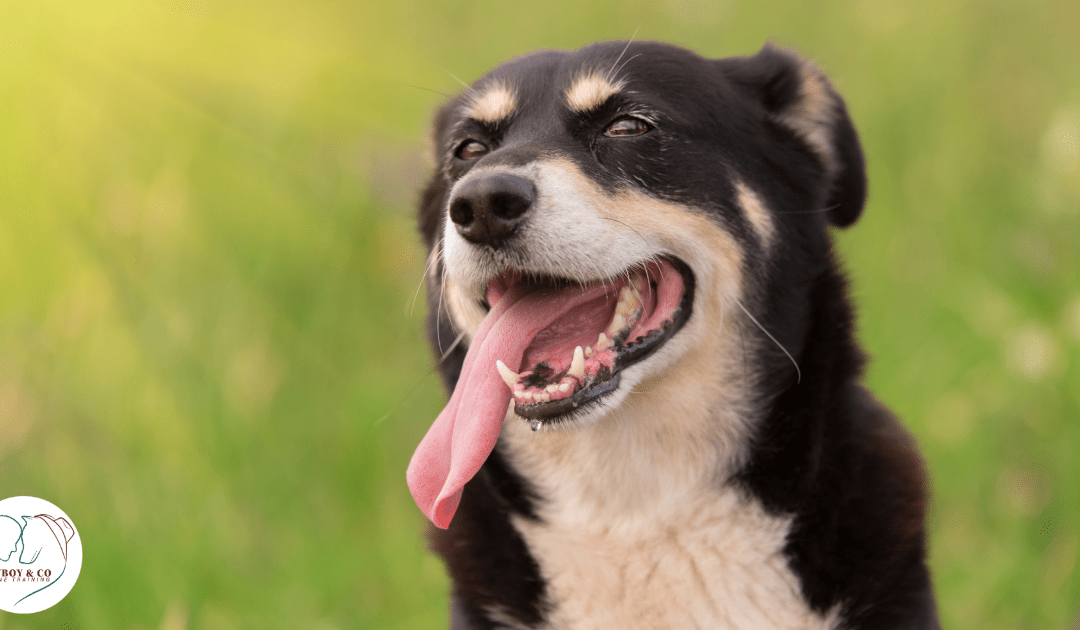
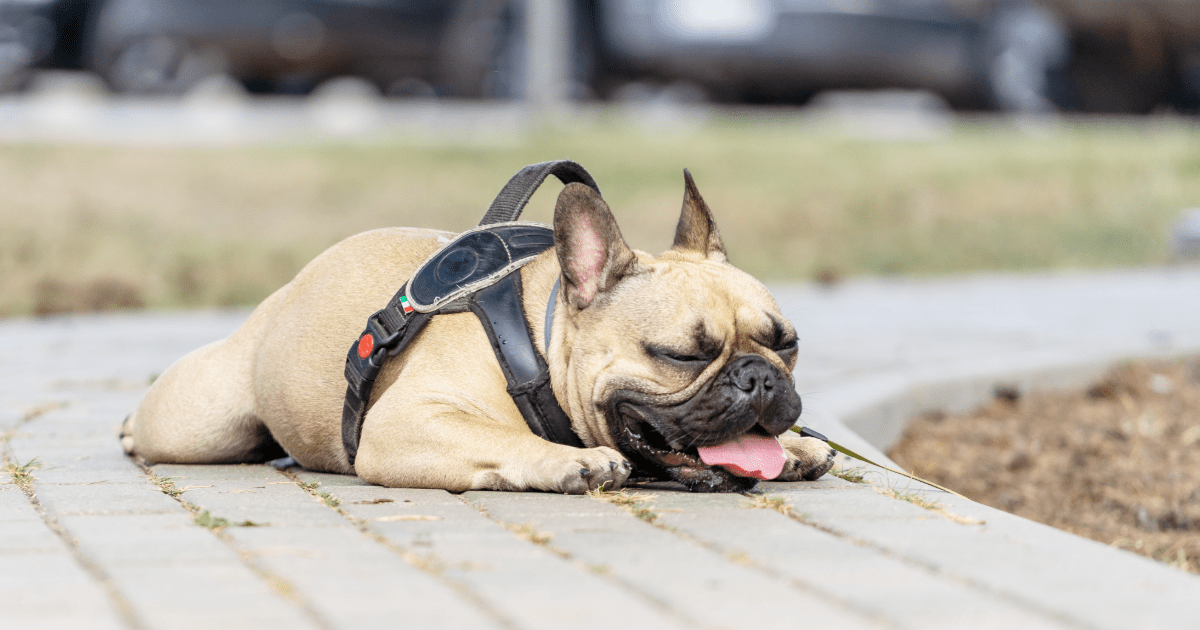
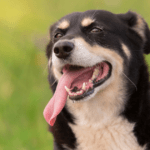
Panting that becomes more obvious and exaggerated. A dog’s panting progresses as they get hotter. It starts with their mouth relaxed and slightly open. As their body temperature rises, their mouth opens wider, their tongue swells up a little and hangs to the side. If their tongue is hanging off to the side, it’s time to cool them off.
Restlessness or whining. Even if your dog is really vocal normally, they’ll express their discomfort even more so…or in the opposite direction and might be disturbingly quiet. Look for odd behaviors like an inability to get comfortable or unusual whining.
Trouble catching their breath. This is like when you’ve been out in the heat working, then come inside and have trouble getting your breathing to slow down initially. Your body is still trying shed excess heat.
Excessive drooling that gets thicker and rope-like. Even if your Saint Bernard slobbers like it’s going out of style, it’ll get even worse.
Lethargy or reluctance to engage. An overheated dog will most likely be less interested in doing anything with you or for themselves.
Spoon tongue — everyone talks about spoon tongue. But what does that mean? In the case of heat stress or stroke, your dog's tongue will spread out at the tip and the edges will curl in, like a spoon or ladle. To put it another way, if you look at your dog's tongue and your first thought is... "How do you fit that thing in your mouth?" Your dog is probably overheating.
Most dogs with heat stress can recover on their own if you give them the chance with some shade, water, A/C, and a cool tile floor.
But if you miss that window, heat stress can easily turn into heat stroke.
When Heat Stress Becomes Heat Stroke
If heat stress tips over into heat stroke, we have left the “wait and see” territory and entered medical emergency territory.
At this point, the dog’s body is no longer able to cool itself effectively, and internal temperatures typically climb above 105°F.
The signs are hard to ignore once you know what you’re looking for:
Very intense panting or breathing that seems truly frantic. Because your dog's main cooling system is through panting and the tongue, when it seems frantic or so intense they can't calm it down, it can be a sign of heat stroke.
Tongue that does not fit in the mouth. Their tongue will be swollen, spread out, and become truly ladle-like. While this can happen in heat stress, it's more extreme when it tips over into heat stroke.
Gums that are bright red, pale, or even bluish instead of a normal pink. Changes in gum color can often indicate something wrong, so keep an eye on your dog's gums when they're out in the heat.
Vomiting or diarrhea.
Disorientation, stumbling, or acting “out of it." Any sudden behavioral changes like this are warning signs of something bigger.
In severe cases, seizures or loss of consciousness can happen.
What’s happening here is bigger than just “being too hot.” The body is struggling system-wide, and without intervention, it can lead to organ damage or worse.
And the part most people don’t realize is how fast this can happen. It's sometimes much faster than you’d expect based on how the day “feels.”
What To Do in the Moment
Whether it's heat stress and they just need to cool off, or heat stroke and you're on the way to the vet. There are simple things you can do to cool them off safely. Beginning with getting them out of the heat immediately. Get to some shade, inside the house, or your car with the A/C running.
When it comes to cooling them down, this is where people mean well… and sometimes make things worse.
Do not completely soak your dog or submerge them in water.
This can easily cause blood vessels to constrict and make it harder for them to thermoregulate. It can even send them into shock.
Instead, use cool but not ice cold water and splash it on the belly, armpits, and paws. Get them to lay down on a wet towel somewhere with air movement — a portable fan is a great option. Your goal is gradual cooling, not shocking their system.
If they've shown any signs of heat stroke (not just stress), don’t wait to see if they “bounce back.” Just go.
Even if they seem better after a few minutes, heat stroke can cause internal damage that you won’t see right away. They still need to be checked out by a vet.
Why This Happens So Easily in North Texas
Dogs just aren’t built for North Texas summers.
The only sweat glands they have are in their pads, and panting is their main cooling system. So, when the temperature and humidity both climb, their system gets overwhelmed.
When you add in hot ground, direct sun, and a little bit of activity, it creates a situation where heat builds faster than it can escape. That’s where dogs get into trouble.
Dogs That Need Extra Consideration
Some dogs just can't take the heat. But if you know it ahead of time, you can plan better.
Be especially careful with:
Flat-faced breeds like bulldogs, boxers, and pugs
Puppies and senior dogs
Overweight dogs
Dogs with thick coats or underlying health issues
With these dogs, I often adjust sessions even more — shorter duration, more breaks, or just moving things indoors entirely.
Prevention Is Everything
This is the part that really matters—the stuff we can control.
Work early in the morning or later in the evening — before 8am or after 8pm.
Make sure there’s always access to cool water and real shade.
Build in more breaks than you think you need.
And the one we all know, but it still needs to be said: never leave your dog in the car. Even when it doesn’t seem that hot, it gets dangerous fast.
A Final Note on Summer Time Training
This is why my summer schedule looks the way it does, with early morning and later evening sessions.
It may look like I'm being overly cautious, when the reality is I understand how quickly things can shift. A productive training session loses its value when the dog overheats and can't cool off.
A safe dog is always the priority. Because in East Dallas, the line between “a little warm” and “a real problem” is a lot thinner than most people think.
DFW Summer Warning: Dallas Pavement Will Hit 135°F — Here's How to Walk Your Dog Safely
North Texas summers are brutal — but the sidewalks will burn your dog’s paws. If you’ve lived the DFW area for at least one summer, you know how hot it gets: summer temps of 95ºF+ by late morning from June through September and sometimes October too.
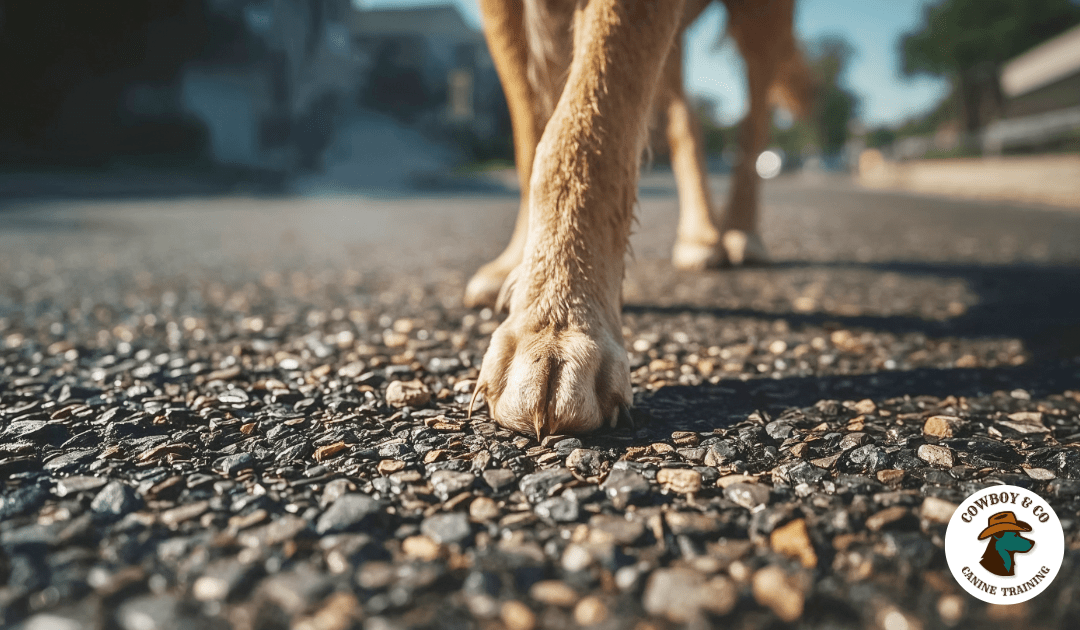
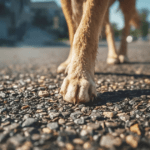
And, before you think, "But my dog's feet are tough," think about it. Would you go barefoot down the street on a hot summer day in Dallas? Tough or not, that pavement gets hot enough to do real damage in under a minute.
How Hot Does Pavement Get in North Texas?
It’s just now June, so we’re still in “pre-heat” mode here in the Dallas area, which means you still have a decent walk window in the mornings and evenings. But soon — maybe even next week — that pavement will be sizzling hot at 9am, even if the air is still mostly comfortable.
Of course, not all surfaces get that hot. So, as long as the air temps and humidity are comfortable, short summer walks in a shaded DFW park or along a trail may be safe, but check first. Just remember that the streets streets and sidewalks are a no-go. They get dangerously hot.
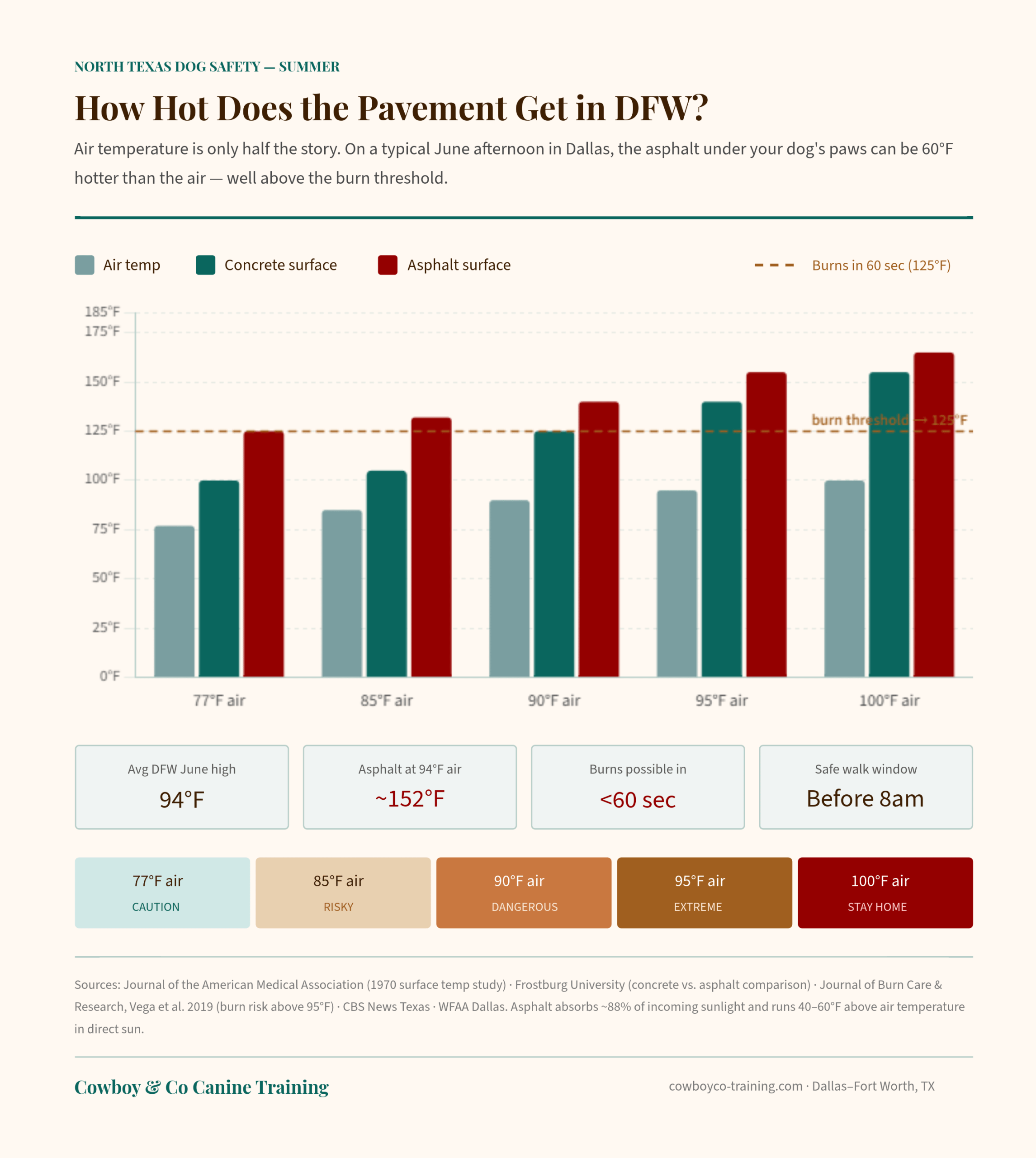
You may have heard that asphalt can reach 135ºF on an 86ºF day. That’s true — but it may be higher or lower, depending on whether it’s getting direct sun or not. But what about the sidewalks — how hot do they get? The short answer is... it depends on the day, but they tend to be cooler than asphalt by a few degrees. To make it easy, I’ve got a handy chart for you, based on actual information from JAMA, Frostburg University, the Journal of Burn Care & Research, and CBS News in Dallas. Feel free to download and share it, I’d also love it if you linked back to my page.
As you can see from the chart, comfortable air temperatures don’t necessarily mean the asphalt or concrete is safe for your dog. Still, the easiest way for you to figure out if it’s too hot is a quick test: place your hand on the ground and hold it for 10 seconds. If you’re comfortable the entire time, your dog’s toe beans should also be comfortable.
Feet work just as well — a friend of mine likes to say that “if I can’t walk barefoot on the sidewalk, neither can my dog.”
Signs Your Dog's Paws Are Burned
If your dog ran around on the back patio in the sun and came in limping, check their paws—they may have burned them. Check for signs of burned paws:
Limping or reluctance to walk
Excessive chewing or licking of their feet
Redness or swelling around their pads
Blistered or peeling pads
Discolored pads
Should any of these signs show up, take action! For mild burns without any blistering, dunk their paw into cold water and keep it there for 5-10 minutes. Then, gently clean it and apply a dog-safe burn balm. If it looks really tender, wrap the paw loosely with clean gauze and monitor for healing.
If your pooch has blistered pads or it looks worse than a slight burn, contact your vet or head to the urgent care clinic.
Best Times to Walk During a North Texas Summer
In June, the sun rises over Dallas somewhere around 6:20am - 6:30am — a perfect time to head out for a walk. In fact, the best time to take your dog for a walk during the summer is before 8am and after 8pm. The morning is terrific, because it's early enough that the sun hasn’t had a chance to heat up the sidewalk, but it’s still light enough to see clearly.
While the mornings and evenings are the safest, the most dangerous time for your dog to be out during the summer months is between 10am and 7pm. Just avoid this stretch. Not only can they burn their paws, but dogs release most of their excess body heat through their tongues and paws.
And remember that once the thermometer hits 85℉ and stays there, it’s safter to skip the walk and play in the water instead.
Plan Ahead for Hot Pavement — Find Shaded, Grassy Options
Still, even if you head out out before 8am, you still need to plan your route. Concrete and asphalt take hours to release the heat they absorb during the day. So find shaded routes with sidewalks and grass that don’t get as hot. Also valuable are the many grassy, shaded parks and hiking trails in and around Dallas. I’ve listed a few here, but the AllTrails app has more to explore and plenty of user reviews with photos to help you decide before you go.
There are also several dog-friendly restaurants with covered patios, so with some planning and creative Googling you’ll find plenty of dog-friendly and dog-safe options.
Protect Dogs and Their Paws During Summer Heat
While keeping your dogs cool is easiest if you keep them in during the hottest part of the day, sometimes the A/C goes out, or an excursion takes longer than you expect. For moments like that, be sure to have a few things on hand:
Dog booties for foot protection. You still need to watch for signs your pooch is overheating, but these can keep your dogs toe beans safe. Warning: they take time and training to get your dog comfy in them. Wagwellies are really popular and lightweight.
Paw wax or balm can offer partial protection and may also be helpful after an outing to soothe the skin. I love Musher's Secret, it's great all year to protect your pup's feet.
Cooling vests. Especially helpful for short-snouted breeds like pugs and those with heavy coats, but they can help all dogs.
Bonus Summer Hazards
As if the pavement wasn’t bad enough during a Dallas summer, there are more summer hazards. We have hot cars, blue-green algae in the lakes, and burrs and foxtails in the grass. All of these can send a dog to the ER or worse. Here's what to look out for:
Foxtails
Those seed heads from several types of grasses dry out and start spreading by grabbing onto your clothes or animals as they pass by. But their "grabby" nature becomes a problem when your dog inhales one or it gets stuck between their toes. They look like smaller versions of wheat stalks, but break apart easily and are very light — making it easy for a dog to sniff one up. Foxtails can work their way into all sorts of places: under the skin, between the paws, and even in a dog's sinus cavity — which requires an ER trip to remove.
Check between paw pads, in and behind ears, and all the nooks and crannies on a dog's body.
Sneezing or reverse sneezing that doesn't seem to quit.
Blue-green algae
While algae of all types are expected in lakes and ponds, sometimes it can bloom to the point of being toxic like blue-green algae. As long as there's been enough rain and the water has been moving, it's usually okay. However, as summer heats up, you'll want to check with Texas Parks and Wildlife to see if the water bodies you plan to visit have been affected by blue-green algae.
So plan a bit, skip a walk or two, and keep your dog safe — if it’s too hot for your feet or your kids, it’s probably too hot for your dog.
Q: How hot does the pavement get during summers in Dallas?
Asphalt can reach 135°F on an 86°F day in direct sun — hot enough to burn your dog's paws in seconds. Concrete runs slightly cooler but is still dangerous during peak hours.
Q: What time should I walk my dog during the summer in Texas?
Before 8am or after 8pm. Once the sun is up, pavement heats quickly and stays hot for hours — even after air temperatures drop in the evening.
Q: How do I know if my dog's paws are burned?
Watch for limping, excessive licking or chewing at their feet, redness, swelling, or blistered pads. For mild burns, soak the paw in cold water for 5–10 minutes. Blistering or severe tenderness warrants a vet visit.