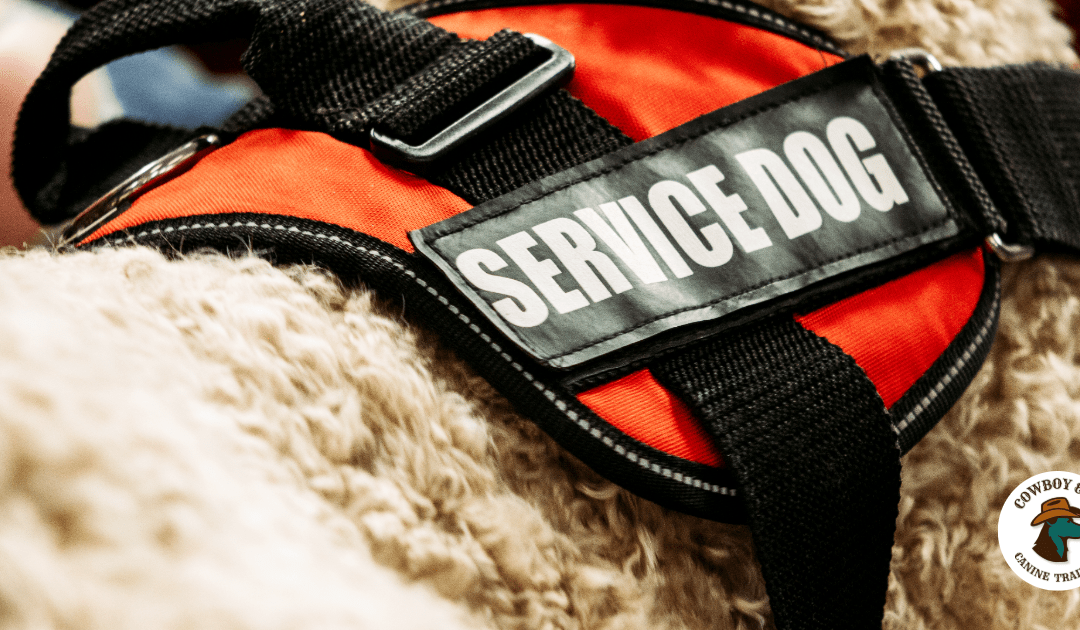
Is Your Dog A Service Dog Prospect? Here’s How to Know
Because I work with service dogs, this question comes up almost daily. Someone falls in love with a puppy at the shelter, or they already have a dog at home, and they want to know if this dog be their service dog? And I understand it — I do. But wanting it to be true and it being true are two very different things. Being honest with you upfront will save you a lot of heartbreak down the road.
Any dog can be trained. Not every dog can be a service dog.
This isn't what you wanted to hear. But the simple truth is that most dogs were not born with the personality traits that make a service dog. You can train behaviors into almost any dog, but you cannot train the right temperament into a dog that doesn't have it. Those are two completely separate things and people get into trouble when they confuse them.
A service dog is way more than a well-trained dog. Services dogs must work reliably, day after day, in every environment imaginable. Crowded grocery stores, hospital waiting rooms, loud events, airports, elevators.
They have to stay focused on their handler when:
- A child runs up screaming
- A cart crashes nearby
- Another dog walks by them
Services dogs have to come right back to work without missing a beat, even when they're getting bumped, jostled, or stepped on. The basic traits that make a service dog have nothing to do with training: the things that make up their temperament cannot be taught.
50%
Industry average washout rate, even in purpose-bred programs
1 in 100
Estimated dogs truly suitable for service work
2 years
Typical time investment to fully train a service dog
Those numbers are pretty standard across the board, it's the baseline before you add in shelter history, unknown genetics, or a dog someone picked because they were cute. It's a lot to absorb, but you need to know it going in.
What you're looking for
I raised Cowboy from the moment he came home at 8 weeks, but before I ever started task training, I spent months watching him. How does he react when something surprises him? Does he recover quickly or does he shut down? Does he want to work with me, or does he want to work on his own terms? You're looking for a very specific kind of dog, and the signs show up early.
Here's what you'll see in a service dog prospect:
Confidence without aggression
Confident dogs investigate new sounds, surfaces, and people. They don't freeze, hide, or bark and that's the dog you want. Fearful dogs don't make service dogs because you're always going to fight against their nature.
Recovery speed
Stuff happens in public and your service dog will get started. But how fast do they come back? That's what you need to know, because a good prospect bounces back almost immediately. Dogs that stay rattled, keeps scanning, and can't settle is telling you something important about their nervous system.
Handler focus
This is a big one, and even purpose-bred pups sometimes struggle. Dogs that are too independent and work with you on their terms aren't good prospects. A great service dog prospect wants to work with you. They'll check in regularly, seeking that interaction. These dogs find value in that partnership and it's what makes the training work.
Sound stability
Loud noises are part of life in public. Services dogs have to be able to hear cars backfire, crowd noise, or fire alarms — and keep working. If a dog is sound-sensitive, that's a big problem for service work that can't usually be conditioned away.
Touch tolerance
In public, strangers are going to reach out. Kids are going to pet without asking. The dog gets bumped in tight spaces. A service dog prospect has to accept handling from anyone without tension, stiffening, or pulling away. Low touch sensitivity is non-negotiable.
Food and toy drive — but controlled
You need a dog that's motivated enough to work but not so over-the-top that they can't focus. Too little drive and you have nothing to work with; too much and the dog can become a liability in public. You're looking for that sweet spot in the middle.
The shelter dog question
I'm not going to tell you it's impossible. Unicorn dogs exist and I've seen shelter dogs become exceptional service animals. But I'll also tell you this: people celebrate those stories loudly, and they stay very quiet about the failures. Because for every shelter dog that made it into service work, there are many more that didn't — and those handlers lost months or years of time, thousands of dollars in training, and in many cases, a real working relationship they desperately needed.
The problem with shelter dogs as service prospects is that you don't know the genetics. You don't know what happened before that dog came through the door. You don't even know if the temperament you're seeing is the real dog or a dog that's shut down because of the stress. Shelter environments are hard on dogs. A dog that seems calm in a kennel might be a completely different animal once it decompresses in a home. That can go either direction — better or much worse.
My honest take
If you have a disability and you need a reliable service dog, a shelter dog is a gamble. It's not that it can never work — it's that you may not be in a position to absorb the emotional or financial cost of failure. If you're plan to go that route anyway, at minimum have a professional trainer evaluate that specific dog before you commit.
And go in with eyes open: even if the dog passes an initial evaluation, temperament issues can emerge months later as the dog matures. There are no guarantees with any dog.
What to look for in a breeder — and why it matters
If you're going through a breeder, the genetics conversation is even more important. A dog from a backyard breeder might technically be the right breed on paper and still have none of the working traits that the breed is known for. Breeders who focus on looks or great pets may have decades of breeding away from the traits that make a working dog. You need a breeder who produces dogs that work, whether it's obedience work, sport, therapy, or ideally, service work.
Look at the parents. Meet them if you can. Are they stable? Do they recover quickly from surprises? Are they interested in people and engaged with the world? The temperament of the parents is the best predictor you have of what you're going to get. Genetics load the gun. Environment pulls the trigger — but if the genetics aren't there, no amount of training will magically create what's missing.
GREEN FLAGS
- Investigates new things calmly
- Recovers quickly from surprises
- Checks in with handler naturally
- Stable around sounds and crowds
- Accepts handling from strangers
- Known, stable parent temperaments
RED FLAGS
- Freezes or hides when uncertain
- Slow to recover from startles
- Easily distracted, ignores handler
- Reactive to sounds or movement
- Tenses up or pulls away from touch
- Unknown history or genetics
The hardest part of this conversation
Sometimes the dog you already love — the one sleeping on your couch right now — is just not the right dog for this work. That doesn't make them a bad dog and it doesn't mean you failed them. It means they're not suited for a job that only a rare few dogs are built for. And the kindest thing you can do for a dog that doesn't have service dog temperament is not put them in that role.
Dogs that are stressed in public, overwhelmed, or unable to decompress is not a happy working dog. That's a dog struggling. The goal of a service dog partnership isn't just functionality for the handler. It's a dog that thrives while doing the work. When it's the right match, you'll know it! The dog is calm, confident, clearly in its element.
If you're trying to figure out whether your dog has what it takes, or you're looking for help selecting the right prospect from the start — that's exactly the kind of conversation worth having with a trainer before you invest years of your life in the process.
I specialize in dog training for family pets and service dogs. Every case of separation anxiety is different. If your dog is showing severe symptoms, working with a trainer one-on-one is always the best first step. Reach out for more information or to set up a free assessment.
FAQs: Service Dog Selection
Can I train my current pet dog to be a service dog? Possibly, but it depends far less on training than most people expect. Training can teach behaviors, but it can't instill the temperament a service dog needs — things like confidence, sound stability, and the drive to work closely with a handler. Before investing time and money in training, have a professional evaluate your dog to see if their natural temperament is a realistic fit for the role.
What's the most important trait to look for in a service dog candidate? Recovery speed is one of the biggest indicators. Any dog will get startled in public — what separates a strong prospect is how fast they shake it off and refocus. A dog that stays rattled, keeps scanning the environment, or can't settle after a surprise is showing you their nervous system that may not be resilient enough for the demands of service work.
Are shelter dogs a realistic option for service work? It's not impossible, but it's pretty rare and there's a bigger chance of losing valuable time and money in training a dog that's not a good candidate. The core challenge is that you simply don't know a shelter dog's genetic background or life history, plus the stress of a shelter environment can mask their true temperament. A dog that seems calm in a kennel may behave very differently once settled into a home — in either direction. If you pursue this route, a professional evaluation before committing is essential.
Why does it matter where a dog is bred if I plan to train it myself? Because genetics determine the ceiling. A breeder focused on appearance or companionship traits may have spent generations selecting away from the working drives and stability that service dogs require. Before choosing a puppy, meet the parents if possible — their temperament is the strongest predictor of what you'll be working with down the line.