You love your dog… and you consistently put in focused time to work with them. So why isn't the training clicking? They may not be ready for what you're asking, but there's also a pretty good chance that you're making at least one of these five common dog training mistakes.
The good news is that every single one of them is fixable.
The hard truth, the one none of us wants to hear, is that dog training problems aren't usually about the dog. There’s usually something happening on the other end of the leash causing it. These may be the most common problems I help my clients solve, they’re pet parents and aspiring handlers doing their level best, working hard, and still wondering why their dog seems confused, distracted, or just plain stubborn.
Nine times out of ten, the answer isn't stubbornness — yes, it can be, but that’s for another article. Most likely, it’s one of these five accidental mistakes. Read through them, be honest with yourself, make changes, and watch things start to shift.
Mistake #1: Repeating Cues Instead of Waiting for a Response
"Sit. Sit. Sit — Buddy, sit. Sit! I said sit. Sit. Siiiiiiiiit." Sound familiar? This habit, which trainers call cue nagging, is one of the most widespread mistakes in dog training — and it directly teaches your dog to ignore you.
Every time you repeat a command your dog doesn't respond to, you're reinforcing a new, accidental rule: "I don't have to respond until I hear it five times." You've accidentally trained them to tune out the first few repetitions.
If you want a human example, think about that kid whose mom says, “At the count of three, you better be moving.” The kid always waits for 2 and a half, don’t they?
Your dog is the same. They can count too!
The same problem shows up with recall. If you say "come" once and your dog doesn't respond, so you keep repeating it. Before long, "come, come, come, come" is the actual command — and a single "come" means nothing.
The fix: say the command once, clearly and calmly. If your dog doesn't respond, reset the situation — move closer, reduce distractions, use a higher-value reward — and try again from scratch. You're teaching them that every cue counts from the very first word. Fixing
Mistake #2: Inconsistent Rules Across the Household
Is your dog allowed on the couch? The answer had better be the same whether it's Tuesday morning or Saturday night — and whether it's you, your partner, or your kids enforcing the rule.
Dogs don't generalize rules from person to person. When the rules shift — on the couch with one person, off with another — your dog isn't being rebellious. They're genuinely confused. They're constantly testing boundaries because you have never set a consistent boundary.
This applies to commands too. If you say "down" to mean lie down, but your spouse says "down" to mean get off the furniture, your dog is getting crossed signals. They can't distinguish — they just know that "down" sometimes gets a treat and sometimes gets a scolding.
The fix: hold a quick family meeting. Agree on the rules and the exact words for each command. Write them down if you have to. Getting everyone in the house consistent is more powerful than any single training technique.
Mistake #3: Rewarding Too Late — Timing Is Everything
Your dog finally holds a sit. You're thrilled. You reach into your pocket, unwrap a treat, and hand it over. Your dog, meanwhile, has already stood up, sniffed the floor, and started walking away. You just rewarded that.
Dogs connect reward to whatever they were doing in the last second or two before it arrived. When the treat comes late, you're not reinforcing the behavior you wanted — you're reinforcing the sniffing, or the moving away, or just random standing around.
This is why many trainers use a marker — a clicker, or a sharp "Yes!" — to bridge the gap. The marker fires the instant the desired behavior happens, then the treat follows. Your dog learns that the marker means "that thing you just did earns a reward," even if the treat takes a moment to arrive.
The fix: keep treats in an easily accessible spot before every session. Practice clicking or saying "Yes!" the moment the behavior happens, then follow with the treat. Clean timing makes everything else work better. It's the single fastest way to speed up your dog's progress.
Mistake #4: Training Sessions that Go on Too Long
When training is going well, it feels productive to keep going. But your dog's attention span has a hard ceiling, and pushing past it doesn't build on your progress — it erodes it.
Most dogs start losing focus after 10 to 15 minutes. Many puppies tap out around 5. A dog that's mentally fatigued isn't learning anymore because they're making mistakes and getting frustrated. Sessions that drag on can actually create a negative association with training, making future sessions harder.
More sessions, shorter in length, are almost always better than one long marathon. Three 5-minute sessions spread through the day will outperform a single 45-minute slog every single time.
The fix: set a timer. Keep sessions to 5–10 minutes for puppies and 10–15 minutes for adult dogs. Always end on a win — ask for something your dog already knows well, reward it generously, and stop while they still want more. Leaving them wanting more is how you build a dog that looks forward to training.
Mistake #5: Accidentally Reinforcing the Behavior You're Trying to Stop
This one catches almost everyone. Your dog jumps on you when you walk in the door — so you reach down, make eye contact, and say "No, down!" in a firm voice. From your perspective, that was a correction. From your dog's perspective, they jumped on you, and you immediately gave them your full attention. They did it right!
Dogs don't really distinguish between positive and negative attention the way humans do. Any attention — including scolding — can reinforce a behavior. If your dog barks at the back door and you open it up to quiet them, you've taught them that barking opens doors. If you slip food from your plate to stop the begging, you've taught them that begging reliably produces food.
The same principle works in your favor: behaviors that get rewarded get repeated. So the goal isn't just to stop reacting to the bad stuff — it's to actively catch and reward the good stuff before the bad stuff has a chance to start.
The fix: for unwanted behaviors, remove all attention. Turn away, cross your arms, and wait. The moment your dog offers something acceptable — sitting instead of jumping, quiet instead of barking — that's when you engage. A dog who is sitting cannot simultaneously be jumping up.
The Bottom Line
None of these mistakes make you a bad owner. They make you a normal human who loves their dog! I’ve caught myself doing most of these things at different times and so have the other trainers I know. Learning how to spot your own mistakes is sometimes the hardest part. You can try recording training sessions if you suspect something on your end is going wrong. The objective view of the camera lens often exposes things we didn’t know we were doing.
The shift from frustrating to rewarding training doesn’t mean learning a dozen new techniques. It's about cleaning up these foundational habits: say it once, keep the rules consistent, reward at the right moment, keep sessions short, and pay attention to what you're accidentally teaching.
Get those five things right, and you'll be amazed at the changes you see. They were born ready — they were just waiting for clear signals.
Ready to get some expert eyes on your training? Book a free consultation with to find out how I can help you.
FAQ: Common Dog Training Mistakes
Q: Why does my dog ignore me when I give a command or a cue?
Probably because you've accidentally taught them they don't have to listen the first time. If you say "sit, sit, sit — Buddy, sit, SIT" every time, your dog has learned that the real cue is the fifth repetition — not the first. Trainers call it cue nagging, and it's one of the most widespread mistakes out there.
Q: Why does my dog listen to me but not my spouse / kids?
Because the rules aren't the same coming from each person, and your dog knows it. Dogs don't generalize rules from one person to another. If they're allowed on the couch with one family member but not another, they're not being stubborn — they're confused, and they're constantly testing because no consistent boundary has ever been set. Same goes for commands: if "down" means lie down to you and get off the furniture to your spouse, your dog is getting crossed signals every single time.
Q: How do I get my dog to stop jumping / barking for attention?
Stop giving them attention when they do it — and that includes corrections. When you reach down, make eye contact, and say "no, down!" your dog doesn't hear a scolding. They hear: "I jumped on them and immediately got their full attention." Dogs don't distinguish between positive and negative attention the way we do. Any reaction can reinforce a behavior. The move is to turn away, cross your arms, and wait. The second they offer something better, like a sit, or just standing calmly in front of you, you engage.
If your dog barks, lunges, or melts down on leash, you’re not alone. Leash reactivity is one of the most common—and most misunderstood—behavior problems dog owners face.
One minute you’re walking. The next, your dog is pulling and barking, while you desperately try to get them under control...and everyone around you stares. It's frustrating and sometimes frightening, but leash reactivity is manageable, and most dogs improve with the right approach. I'm breaking down what leash reactivity is, why it happens, and how to help a reactive dog feel calmer and more in control on walks.
What Is Leash Reactivity?
Leash reactivity is an intense emotional response to triggers while a dog is on leash. Some pet parents have described them as panic attacks. But it's not always a fear response, it can also be a buildup of frustration. For example, those squirrels your dog loves to chase across the backyard?
That's fine when your dog's free to chase them, but add a leash into the mix and your dog can get frustrated because they can't go where they want. That frustration can easily overwhelm a dog to the point where it becomes explosive. At that point, they have no choice but to release it somehow.
Common triggers include:
Other dogs
People
Bikes or strollers
Trashcans out of place
Bags being blown down the street
Common Signs of a Reactive Dog on Leash
There are a few typical signs of leash reactivity that can look aggressive—especially when your dog is barking or lunging. If your dog does some or all of the following, there's definitely some reactivity going on:
Barking or lunging at dogs or people
Whining or crying when approaching triggers
Fixation and hard stares
Trying to hide or escape
Stiff posture and dilated pupils
When these behaviors only happen when your dog is on-leash, you're most likely dealing with leash reactivity and not aggression. But if you're at all unsure, please find a professional dog trainer who can help you figure it out.
Reactive does not mean aggressive.
The very first reactive dog I worked with was a big Pyrenees. He didn't have a mean bone in his body, but while I was working with him a little Maltese walked by us. The Pyrenees instantly started reacting. My boss at the time told me to just keep him in a heel, keep working with him. This poor dog got so frustrated that he finally reached his tipping point — as trainers say, he went over threshold. When he did, he crouched down, and jumped up on his hind legs and did a sort of bear attack. He pawed it me with his front legs, he never actually tried to bite, he was frustrated and didn't think he had any other options.
Most reactive dogs are like this: afraid, frustrated, or just overwhelmed and overstimulated by whatever is going on — almost no reactive dog actually wants to attack. Yes, there are a few truly aggressive dogs, but in my experience those are few and far between. Unfortunately, reactive dogs get labeled as aggressive because we humans don't understand dog behavior.
The leash itself often makes things worse, because when a dog feels threatened or frustrated, their nervous system demands they do one of two things: fight or flight. When they're leashed, the flight option is taken off the table entirely. So, they lash out and the reaction escalates because they don't see a way out.
Why Dogs Become Reactive on Leash
It's easy to believe that your dog's explosive leash behavior is deliberate, and many frustrated pet owners thought their beloved pooch was being stubborn or trying to be dominant. If your dog is reactive, remember that this is an emotional response with absolutely no thought behind it.
Common causes of leash-reactivity (and other types of reactivity) include:
Limited or poor early socialization
Past negative experiences
High‑drive or high‑arousal genetics
Accidental reinforcement from handlers
Over time, dogs learn that barking and lunging make the scary thing go away. That relief reinforces the behavior, making reactions stronger and faster. Over time, it develops into a dog that you can't take anywhere, for fear of them losing it on some poor, unsuspecting skateboard.
Early Signs of Leash Reactivity
Reactivity doesn’t start with barking—it starts quietly. It's up to us to identify these things before they escalate. When you can catch it before your dog goes over threshold, you can manage it. Watch for things like:
Hyper-vigilance
Sudden stiffness
Hard staring
Whale eye or pinned ears
This progression is often called the stress ladder. Once a dog crosses their threshold, learning stops and reactions take over. Any training you hope to do must happen before that point. Don't bother trying to work with them when they're in the middle of a reaction, because their brains have essentially shut off.
Short‑Term Management for Leash Reactivity
Management lowers stress while you're working on the problem, but they aren't long-term solutions. However, they'll help you bridge the gap while you work with your dog. Effective strategies include:
Using well-fitted collar they cannot slip out of, such as martingale collars
Walking during low‑traffic times
Creating distance with U‑turns
Remember that management isn’t avoidance — it’s setting your dog up to succeed so they can make gradual progress without reinforcing the problem.
Training Methods That Help Reactive Dogs
Because leash reactivity is emotional, change happens gradually. It's okay to push just a little at a time, getting them right up to the edge of their limit, but don't do it every time.
Counter‑conditioning Pair triggers with positive outcomes at safe distances. The idea is that they'll see their trigger at a distance, and you offer a high value reward to keep them focused on you. Eventually, they begin associating their trigger with positive emotions instead of fear or anxiety.
Desensitization Expose your dog to triggers below threshold, increasing difficulty slowly. Desensitization works by gradually reducing your dog's emotional sensitivity to whatever sets them off. So you start with them at the far end of their threshold where they can see and possibly look at their trigger, but stays relatively calm. Over time, you work your way closer and closer as they develop more self-confidence and become less reactive.
Look At That (LAT) Teach your dog to notice triggers without fixating, then re‑engage with you. For this, you teach dogs that looking at stuff while still able to break away and look back at you earns rewards (treats, toys, praise). Once that part is solid, you add the trigger at a safe distance that's still under their threshold. Follow the same procedure, moving closer over time.
Support tools Short‑term calming supplements or medications may help some dogs learn more effectively. If you get stuck, reach out for professional guidance. It's hard to see the full picture when you're in the middle of the fight.
Mistakes That Can Worsen Leash Reactivity
When you're in the middle of reactivity, it's tempting to try to force the issue, punish or correct reactions, or get impatient. However, those are all things that will set you back and possibly entrench your dog's reactivity even further. Along with that, you and your family members must be on the same page. If your spouse or partner constantly pushes your dog over threshold, it's going to get worse. In the end, every dog is different and you're not looking for perfection, but progress. So remember that your dog's progress will look different at different stages:
A calm glance instead of a lunge
Grumbling and whining instead of barking
Looking at you instead of the trigger
Mark and reward the progress when you see it, and your dog will give you more of that. Then, you start rewarding the next bit of progress.
Can Leash Reactivity Be Fixed?
Yes! The good news is that most reactive dogs improve significantly with consistency, clarity, and patience. Leash reactivity doesn’t mean your dog is broken. It only means they need help learning how to feel safe and think clearly.
If leash reactivity is making walks stressful, professional help can speed things up. Reach out to me to get support tailored to your dog.
Frequently Asked Questions
What causes leash reactivity in dogs?
Leash reactivity is usually caused by fear, frustration, or overstimulation combined with the restriction of a leash.
Is leash reactivity the same as aggression?
No. Most reactive dogs are not aggressive — they’re overwhelmed and unable to cope in the moment. Another way to put this is to imagine yourself in a panicked moment: are you thinking clearly or just responding on instinct to whatever is in front of you? Now imagine your dog in the same situation: they don't understand human speech, only the tone, and they don't have the context to understand what's going on.
Can a reactive dog be trained?
Yes. With proper management and behavior modification, most reactive dogs show significant improvement. Some even become social butterflies!
Should I punish my dog for reacting on leash?
No, punishment often increases their anxiety level and makes the problem worse. Remember, your dog is reacting, not thinking. So punishment can increase that fear-based response. Addressing emotions is more effective.
Your dog sits. They walk nicely on a leash. Most of the time they come when you call, and they even remember to sit when meeting someone new. You've put in the work — and it shows.
Yet, the problem is that a dog who only ever practices at home is a dog who only knows good behavior at home. The real world is where training becomes a lifestyle. And honestly, that's where the fun really starts, with some dog-friendly locations you can take your pup.
Why Getting Out Matters (It's Not Just About Socialization)
Taking your dog out into the world builds on their foundation in a way that backyard sessions simply can't. New environments, new smells, new sounds, new people — it's all information your dog is learning to process calmly and confidently.
Dogs who get out regularly tend to be more adaptable and more fun to be around. They've seen enough of the world that a shopping cart, a kid on a skateboard, or a stranger in a hat doesn't send them over the edge. That calm, unflappable dog you see trotting happily through a store didn't happen by accident — they've been out there enough that the world stopped being surprising.
It also keeps their training sharp in a way a backyard session never quite can. Asking your dog to heel past a display of squeaky toys is a whole different ask than heeling in your kitchen. And that's the point.
One thing worth saying many, many times: socialization isn't a fix for problem behavior, and it's not just for puppies. It's what you do because your dog has a solid foundation and is ready for more.
Making the Most of an Outing
Before you load up and head out, keep a few things in mind:
Match the environment to where your dog is. A dog who's solid at home but newer to public spaces shouldn't start at a packed Saturday farmers market. Instead, choose a quieter store on a weekday morning or a park during off-peak hours. Build up from there.
Bring treats and stay engaged. This isn't a day off from training — it's training with better scenery. Keep your dog checking in with you, reward the good stuff, and make yourself the most interesting thing out there.
Read your dog. Even well-trained, well-behaved dogs have a limit. Watch their body language and learn the difference between alert-and-curious and starting-to-get-uncomfortable. You don't have to push to the edge every time to make it worthwhile.
End on a win. Leave before they get tired or overstimulated. A shorter outing that ends well does more for your dog than a long one that ends after they've already mentally checked out.
Dog-Friendly Parks & Trails in Richardson & Garland
The Dallas area has a ton of great spots to take a well-behaved dog. Most parks are busiest on weekends, so gauge your dog's readiness and plan accordingly. Here are a few locations to get you started:
Huffhines Park — 300 N Plano Rd, Richardson
Cottonwood Park — 1301 W Belt Line Rd, Richardson
Spring Creek Nature Trail — Spring Creek Trail, Richardson
Prairie Creek Waterfall — 2520 W Prairie Creek Dr, Richardson
Lookout Park — 1600 E Lookout Dr, Richardson
Durham Park — 410 S Weatherred Dr, Richardson
Spring Creek Forest Preserve — 1770 Holford Rd, Garland
Dog-Friendly Retailers
Beyond the obvious pet stores, a handful of retailers in the area welcome dogs inside:
Bass Pro Shops — 5001 Bass Pro Dr, Garland
Scheels — 4450 Destination Dr, The Colony
Lowe's — 501 S. Plano Rd, Richardson
A note on Home Depot: many people assume all locations are dog-friendly — they're not. It's store by store, so call ahead before you go.
Get Out There!
The dog who handles the world well isn't born that way — they're consistently taken out into it by an owner who did the foundational work first. If your dog has that foundation, the best thing you can do now is use it.
If outings still feel more stressful than fun, that's usually a sign there's a little more groundwork to lay — and that's completely okay. That's exactly what we're here for. Reach out and let's talk about where your dog is and what they're ready for — whether that's private lessons, a Board & Train program, or just a quick conversation about next steps.
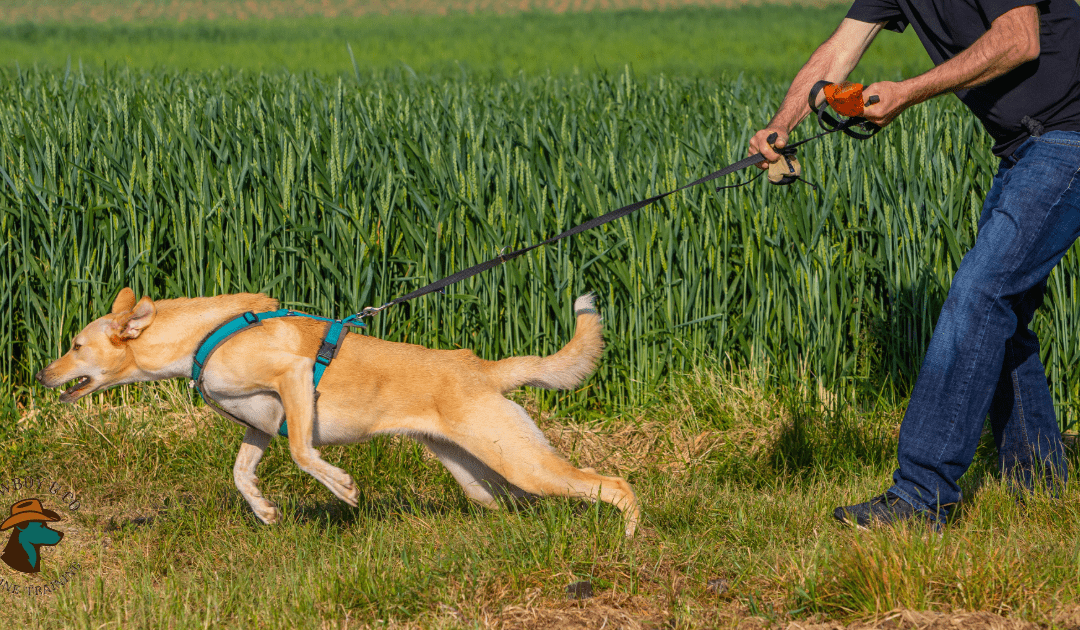
Leash pulling is probably the number one thing people ask me about. And honestly, it's one of the most fixable problems — once you understand why it's happening in the first place.
The short version: your dog pulls because pulling works. Every time they lunge toward something interesting and you follow, they learn that pulling is the correct strategy. They're not being dominant. They're not trying to take charge of the walk. They just figured out the most efficient way to get where they want to go.
So the fix isn't about being more forceful. It's about changing the equation.
How People Accidentally Make Leash Pulling Worse
The most common approach I see is constant leash pressure — a kind of low-grade tug-of-war where the owner holds back and the dog leans forward and they both just suffer through it.
The problem is that steady tension actually teaches your dog to pull against steady tension. It becomes background noise. They stop noticing it, and you've got a dog who tows you down the sidewalk without even registering that you're on the other end of the leash.
The other common mistake is letting the walk happen whenever the dog decides it's happening. Your dog hits the end of the leash, you follow, and the whole thing repeats until you're home. From the dog's perspective, the walk ran exactly as planned.
What Does Loose-Leash Walking Look Like?
Before we fix anything, let's get clear on what we're working toward. Loose-leash walking doesn't mean your dog walks in a perfect heel at your left knee the entire time. That's heel work, and it's a different skill.
Loose-leash walking means there's slack in the leash. Your dog can sniff around, check things out, walk at their own pace — as long as the leash isn't tight. It's a reasonable expectation for a normal walk, and it makes the whole experience better for both of you.
How I Teach Dogs to Walk Nicely
I teach loose-leash walking in two phases: building the right association first, then proofing it in the real world.
Teach the Leash to Mean Something
Before we ever worry about the walk, I want the dog to understand one thing: a tight leash is information, not a battle. When the leash gets tight, movement stops. When it goes loose, movement resumes.
Start in a low-distraction area — your backyard, a quiet hallway, wherever your dog can actually think. The moment your dog hits the end of the leash and creates tension, you stop completely. No verbal correction, no yanking back. Just stop.
Wait. The second the dog adjusts and the leash goes slack — even slightly — mark it (a cluck, a 'yes,' whatever you use) and start moving again. That's the whole game at first.
Most dogs figure this out faster than their owners expect. Within a few sessions, you'll see your dog start to self-regulate — they hit the end, they feel the pressure, and they back off before you even have to stop.
Reward What You Want
Once the dog understands that tension stops the walk, we start rewarding them for actively choosing to walk near you. This is where a lot of people skip ahead too fast and wonder why it's not working.
When your dog is walking calmly with slack in the leash, mark it and reward. Not constantly — you're not a treat dispenser — but enough that your dog starts to realize that staying near you is actually the most productive strategy.
Over time, you're building a dog who chooses to walk with you rather than a dog who's simply being prevented from walking ahead of you. That's a completely different dog to walk.
A dog who chooses to walk with you is a completely different animal than a dog who's simply being held back. That's the goal we're working toward.
What About Equipment?
People ask me a lot about harnesses, head halters, no-pull devices. In my experience, equipment is never a solution or substitute for training, it's part of a carefully considered approach that communicates in a way that your dog understands. It's that communication that's often missing when you're struggling at the end of the leash.
Some dogs — especially large, strong dogs with a lot of drive or a serious pulling history — do benefit from additional communication tools during training. Each case is different and I work with the dog in front of me, making adjustments as needed.
When the Problem is Bigger than Leash-Pulling
Sometimes what looks like leash pulling is leash reactivity. This dog isn't just moving forward, but fixating, lunging, and losing their mind over specific triggers. This is a different problem with a different solution, and managing it the same way as regular pulling usually doesn't work.
If your dog is calm on leash in some environments and explosive in others, it's more likely a reactivity issue worth addressing separately—one that I also help owners solve.
How Long Does It Take?
Depends on the dog, the history, and on how consistent you are outside of sessions. A young dog with no strong pulling habits might get this in a week of daily work. A dog who's been dragging their owner for three years is going to take longer — the habit is deep and the reinforcement history is long.
Either way, it's fixable. I've never met a dog that couldn't learn to walk on a loose leash with the right approach and enough patience.
When you went looking for a dog trainer, did you get overwhelmed with all the hype? You're not alone! Finding the right dog trainer is about more than hype, good marketing, or branded training. And, while there are some excellent programs for dog trainers that offer certifications in their particular method, there is no licensing board. No board exam. No minimum hours. No governing body that can pull someone's credentials if they hurt a dog or take someone's money and disappear.
Anybody can call themselves a dog trainer.
If that sounds a little scary, I get it.
On the one hand, it means that truly passionate but broke people can learn a trade that feeds their families without an unaffordable entry fee—most of us learned how to train dogs by starting with our own and falling in love with helping other people train theirs. On the other hand, it does mean that you, as a dog owner, need to know how to figure out the good from the not-so-good or downright bad.
In all honesty, I don't see a lack of a licensing board a bad thing, because bad players exist in every industry—board licensing or not.
There are thousands of massively skilled, ethical trainers out there who commit to professional development, care deeply about the families they serve, and always try to do the right thing. So sometimes the difference between the "right" and the "wrong" dog trainer comes down to simple preference ... and whether you can work together.
But there are also people who watched a few YouTube videos and decided that was good enough, and that teaching dogs is easy. Those are the individuals I'm trying to protect you from, and I hope my advice helps.
Here's how I'd approach it if I were looking for someone to work with my dog.
Start with Their Philosophy
Ask any trainer you're considering to explain their training philosophy. Not their sales pitch—you're looking for their real-world approach. How do they teach a new behavior? What happens when a dog gets it wrong? What tools do they use and why?
You're not necessarily looking for a specific answer. You're looking for someone who can give you a clear, thoughtful one. If a trainer can't explain their methods in plain language, that's a problem: Either they don't fully understand what/why they do what they do, or they're hiding something.
Be a little skeptical of anyone who tells you their method is the only correct one. Dog training has room for nuance—a lot of it. A trainer who dismisses entire schools of thought without being able to explain why usually hasn't engaged with them seriously enough to have a real opinion.
Look for Transparency, Not Just Reviews
Reviews on Google, Yelp, and Facebook matter. A trainer with dozens of five-star reviews over several years is a good sign. But reviews don't tell you everything—they tell you people were happy, not necessarily that the training held up six months later or that the methods were sound.
Look for trainers who are transparent about their process. Do they explain what a first session looks like? Do they talk openly about what they can and can't help with? Do they have video of actual training sessions—not just before-and-after highlight reels?
A trainer who's confident in their work tends to show it. One who's hiding behind vague promises and cinematic marketing videos might not have as much to show.
Ask About Continuing Education
The best trainers I know are still students. They go to seminars. They work under people who know more than they do in certain areas. They study methods they don't personally use, because understanding something doesn't mean you have to agree with it or even use it.
Ask any trainer you're considering: what's the most recent thing you learned? Who do/did you study under? What certifications or continuing education have you pursued?
The specific answer doesn't matter as much as whether they have one. A trainer who stopped learning the day they started training is a trainer who's been running on the same information for years—and the field has moved.
Find a Dog Trainer You Actually Like
This sounds obvious, but it matters more than you might realize. You're going to be working with this person closely. You'll have to take direction from them, ask questions, and trust their judgment about your dog. If something feels off in the first conversation, pay attention to that.
A good trainer is patient with you, not just with your dog, because sometimes the hardest part of dog training is teaching the humans who love them to communicate clearly in a way the dog understands. A great trainer will explain things clearly and won't make you feel stupid for asking basic questions.
They're also honest with you even when the honest answer isn't what you want to hear.
Dog Training Red Flags Worth Taking Seriously
I've seen enough of the industry to know what problems look like before they develop. Walk away if they:
guarantee specific results before meeting your dog—no ethical trainer does this because there are way too many variables.
can't or won't explain their methods in plain language—insecure and inexperienced people throw a bunch of jargon around without clear explanations.
suggest keeping training methods secret from you 'so your dog doesn't catch on'—how exactly are you supposed to maintain your dog's training later on?
are reluctant to let you observe a session or visit a board and train—would this fly in your kids' kindergarten?
shame or frighten you about your dog's behavior to pressure a sale.
dismiss your concerns about methods without actually addressing them.
price is shockingly low — quality training requires real time and skill, and that costs something.
have no plan for what happens if a method isn't working for your specific dog.
Your dog can't advocate for themselves. It's on you to find someone who deserves to work with them.
Questions to Ask Before You Book
Here's a short list I'd run through with any trainer I was considering:
How long have you been training professionally?
What's your training philosophy, and what tools do you use?
Can you describe what a first session with my dog would look like?
What happens if my dog's behavior doesn't respond to your approach?
Do you offer follow-up support after the program ends?
Can I speak with or read reviews from past clients with a similar situation to mine?
A trainer worth hiring will welcome every one of those questions.
One More Thing
I'm obviously going to think I'm a good trainer. So I'm not writing this to tell you to hire me. I'm writing it because I've seen people go through expensive, ineffective, and sometimes harmful training experiences—and most of them could have been avoided with a little more information upfront.
Do your homework. Ask hard questions. And find someone who treats your dog like an individual, not a problem to be fixed.
Board and train dog training programs sound almost too good to be true, right? You drop your dog off, you pick them up a few weeks later, and they're a different animal. Calmer. Focused. Actually listening.
Sometimes that's exactly what happens, especially with a good board and train program. Other times, people get their dog back, spend a few days at home, and watch everything fall apart. Two weeks later it's like the training never happened.
Here's why that happens, plus what to look for if you're considering a board and train near you in North Texas.
What a Board and Train Program Is
In a board and train program, your dog lives with the trainer — or at a training facility — for a set period of time, usually two to six weeks. During that time, the trainer works with your dog throughout each day, building skills and reinforcing behaviors during real-life situations.
The big advantage is immersion. Instead of a one-hour session once a week, your dog is learning in context all day, every day. That consistency speeds things up for a lot of dogs.
At Cowboy & Co., when a dog is with me for a board and train, they're with me. Not a staff member. Not a kennel with training sessions sandwiched in. Me. That matters — and it's one of the first questions you should ask any trainer you're considering.
When Sending Your Dog to a Board and Train Makes Sense
Board and train isn't for every dog or every situation, but it's often the right call when:
You have a busy schedule and genuinely can't commit to consistent daily training sessions
You're working with a high-drive dog who needs a lot of repetitions to really nail a skill
You want to lay a strong foundation before starting private lessons as a follow-up
You're preparing a dog for a specific role like service or therapy work
However, and this is critical to understand, board and train is not a replacement for your involvement. The best programs treat it as a head start, not a handoff. If a trainer sends your dog home and disappears, that's a problem.
The Transfer Session Is Everything
Here's where a lot of board and train programs fail. The dog gets trained. The owner doesn't.
Your dog learned to respond to a specific person, in specific contexts, with specific tools and timing. When they come home and you do things differently — even slightly differently — some dogs begin to lose their mojo. Not all dogs can generalize and understand that different people do things differently. They expect consistency.
This isn't a dog failing, it's a transfer problem.
Any reputable board and train program should include dedicated time teaching you how to handle your dog after training. Not a twenty-minute rundown in a parking lot. Real instruction. Real repetitions with you at the end of the leash.
I build this into every program I run. The dog's progress is only as useful as your ability to maintain it.
Questions to Ask Before You Book with a Trainer
Whether you're considering my program or someone else's, here's what I'd want to know:
Who specifically will be training my dog — the owner, or staff?
Where does my dog sleep and spend downtime? In a kennel or in someone's home?
Will I get progress updates? How often, and what format?
Can I visit during the program?
What does the handoff process look like? How much time will you spend training me?
What follow-up support is included after my dog comes home?
What methods do you use, and can you explain them clearly?
A trainer who gets defensive about any of these questions is a trainer worth walking away from.
Board and Train Red Flags to Avoid
I've seen programs that produce dogs who look great in a demo video and fall apart within a week at home. Here's what to be cautious about:
No updates or communication during the program
Reluctance to let you observe a training session
A handoff that consists of a five-minute demo and a wave goodbye
No mention of what happens if behaviors regress
Trainers who promise specific results without meeting your dog first
Extremely low prices. Quality board and train takes real time and real skill
The goal of a good board and train isn't a trained dog. It's a trained dog and an owner who knows how to keep it that way.
What to Expect After Your Dog Comes Home
Plan for a transition period. Even a well-trained dog needs a few days to adjust to being home. There's a different environment, different routines, different energy. Some dogs come back and immediately show off everything they learned. Others need a little time to settle.
What you do in the first two weeks matters. Follow through on the instructions you were given. Keep the expectations consistent. Don't let things slide because it feels cruel to correct your dog after they were away. Structure is what they know and desire! It's comforting for them, not punishment.
And if something isn't working, call your trainer. A good board and train program doesn't end at pickup, they offer ongoing support to give you the best long-term outcomes.
Need Dog Obedience Help, but You're Not Sure About Board and Train?
Reach out! I read and answer all emails, usually within a day or so.